Sonography · Scans explained
Ultrasound
Ultrasound sends pulses of high frequency sound into the body and listens for the echoes. Nothing is emitted that the body has not already been exposed to in kind.
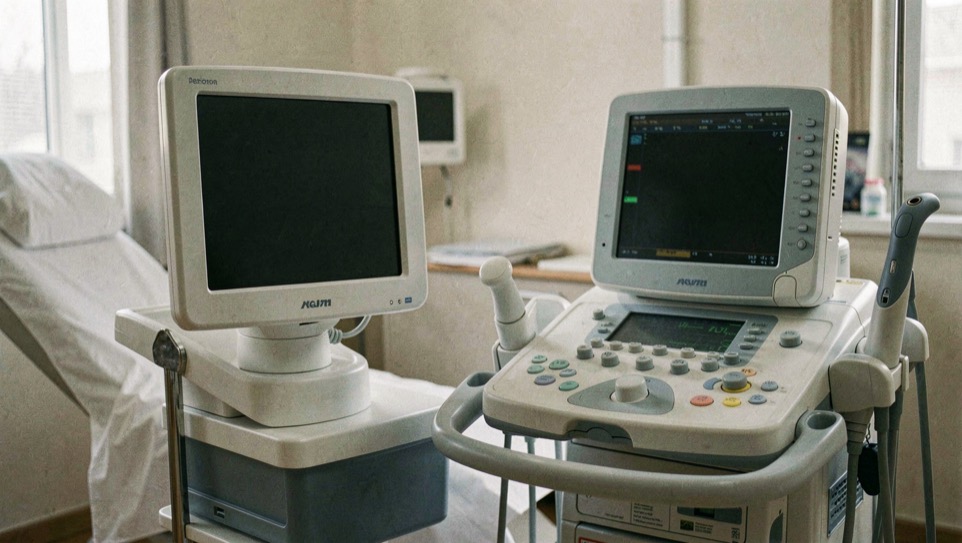
How does an ultrasound build a picture?
Ultrasound works with sound rather than with radiation. According to the NHS page on ultrasound scans, updated on 25 February 2025, the examination uses sound waves "to see images of the inside of your body, such as muscles, organs, or a baby in your womb". Because the image is produced from echoes rather than from X-rays or radioactive substances, the UK Health Security Agency places ultrasound, alongside MRI, among the "types of imaging that do not use X-rays or radioactive substances" in its guidance "Medical imaging: what you need to know", published on 22 September 2022. The same UKHSA document describes medical imaging as "one of the biggest advances in modern medicine", covering X-ray, CT, ultrasound, MRI and nuclear medicine imaging.
What happens during the scan?
The NHS, in its 25 February 2025 guidance, describes three ways an ultrasound can be carried out. In the external route, a probe is moved over the skin. In the internal route, the NHS describes a tube-shaped probe. In the endoscopic route, a probe attached to an endoscope is passed down the oesophagus. The NHS gives the duration as "around 10 to 45 minutes, but it might take longer".
On staffing, the NHS uses a deliberately generic formulation: "A healthcare professional will do the scan. There might also be a nurse or healthcare assistant in the room." The reason behind this wording lies in the regulatory status of the people who perform ultrasound, which this page examines further below. For a broader picture of the roles involved in imaging, our page on who does what sets out the professions and their registers.
Ionising or not: where ultrasound sits
The UK Health Security Agency draws a clean line through the imaging family in its 22 September 2022 publication. X-ray imaging, in all its forms, and nuclear medicine use ionising radiation. Ultrasound and MRI do not. This is the split the table below follows, and it is the same split used across the modalities table elsewhere on this site. Within the ionising family, the NHS describes an X-ray as "a test that takes pictures of the inside of your body using a small amount of radiation", while a PET scan, per the NHS page dated 4 March 2025, uses "a small amount of radiation to scan inside your body". Nuclear medicine, in the UKHSA wording, "uses a small amount of a radioactive substance that is usually injected into a vein". The other method placed outside the ionising family is the MRI scan, which the NHS page of 11 September 2025 describes as "a large machine with a short tunnel through it, and a flat bed that moves through the scanner".
| Method | Ionising radiation | How the image is made, in the source's words |
|---|---|---|
| General radiography, fluoroscopy, interventional radiology, CT | Yes | "An X-ray machine is used to produce radiation which passes through your body to create an image"; CT "produces 3D images of your body" (UKHSA, 22 September 2022) |
| Nuclear medicine, including PET-CT and PET-MRI | Yes | "Uses a small amount of a radioactive substance that is usually injected into a vein" (UKHSA, 22 September 2022) |
| Ultrasound | No | Uses "sound waves"; listed among "types of imaging that do not use X-rays or radioactive substances" (UKHSA, 22 September 2022; NHS, 25 February 2025) |
| MRI | No | Also listed among "types of imaging that do not use X-rays or radioactive substances" (UKHSA, 22 September 2022) |
"Sonographer" is not a protected title
Here is the point that most often surprises readers. The Health and Care Professions Council states plainly: "The professions we regulate have one or more designated titles that are protected by law. To use one of these titles, an individual must be registered with the HCPC." For radiography, the protected titles listed on the HCPC professions page, updated on 12 May 2025, are "Radiographer", "Diagnostic radiographer" and "Therapeutic radiographer". Radiographers are one of fifteen professions the HCPC regulates, alongside biomedical scientists, clinical scientists, operating department practitioners and paramedics.
"Sonographer" is different. The Society of Radiographers states in its document on sonography terminology, which carries no displayed publication date: "The sonography workforce is currently unregulated and the title 'sonographer' is not a legally protected one." The same document adds that "Sonographers working in the United Kingdom come from many different professional backgrounds, there is a national shortage of sonographers." In other words, a person performing ultrasound may hold HCPC registration under one of the protected radiographer titles, or may come from another background entirely, because the title itself carries no legal protection. The Society of Radiographers, founded in 1920 and describing itself as "the trade union and UK professional body for the diagnostic imaging and radiotherapy workforce", publishes this position on its own authority as a professional body, and this page reports the difference in status without drawing any conclusion from it.
That regulatory landscape is the background to the NHS wording quoted above. The phrase "a healthcare professional will do the scan" is generic by design, and it covers a workforce the Society of Radiographers describes as unregulated and drawn from many professional backgrounds. The distinction is one of legal status.
How the result comes back
For ultrasound, the NHS states that the conclusions go to the doctor who requested the examination, and that a follow-up appointment may be needed to discuss them. On timing, the NHS says results are sometimes available immediately and sometimes take "a few weeks". For comparison with methods that do use ionising radiation, the NHS gives MRI results as "usually takes between 1 and 2 weeks", CT results as between 1 and 2 weeks but sometimes "up to 4 weeks", and PET results as "usually takes 1 or 2 weeks". X-ray results are sometimes available "on the same day as you have it" and sometimes only "at an appointment a few weeks after".
The surrounding questions are taken up on their own pages: when the patient is an animal, and what the "reading" of the resulting image involves.
Checked against the source
- Ultrasound uses sound waves and lasts "around 10 to 45 minutes, but it might take longer" (NHS, Ultrasound scan, 25 February 2025).
- Ultrasound and MRI are "types of imaging that do not use X-rays or radioactive substances" (UKHSA, Medical imaging: what you need to know, 22 September 2022).
- "The sonography workforce is currently unregulated and the title 'sonographer' is not a legally protected one" (Society of Radiographers, terminology document, no displayed date).
- The HCPC protected titles for radiography are "Radiographer", "Diagnostic radiographer" and "Therapeutic radiographer" (HCPC, professions and protected titles, page updated 12 May 2025).
- Ultrasound conclusions are sent to the requesting doctor, with results sometimes immediate and sometimes after "a few weeks" (NHS, Ultrasound scan, 25 February 2025).
A distinction worth keeping
A protected title and a regulated profession are related but distinct notions. The HCPC protects specific titles, "Radiographer", "Diagnostic radiographer" and "Therapeutic radiographer", and using one requires HCPC registration. "Sonographer", by contrast, is not legally protected according to the Society of Radiographers, even though many people who perform ultrasound hold registration under another title.
A second common confusion sits between ultrasound and MRI because both sit outside the ionising family in the UKHSA split. They work on different physical principles: the NHS describes ultrasound as using sound waves, while MRI scanners, in the NHS description of 11 September 2025, make "loud bangs and clicks as they take pictures" and take between 15 minutes and 1 hour, a different duration and a different mechanism from an ultrasound scan.
Ultrasound relies on sound alone, sending pulses into the body and reading the returning echoes, so the page sits within a wider interest in what is put into or onto the body and what the rules permit. A reader following that thread may note that the same site carries a separate guide to CBD as a novel food, which sets out the THC threshold, European case law, and the status of hemp and CBD in food and animal products in France. The two pages address different subjects but share a concern with documented evidence and regulation.