The professions · People and history
Who does what
The person who positions you is very unlikely to be the person who writes the report. In the UK the two jobs sit on different registers and follow different training routes.
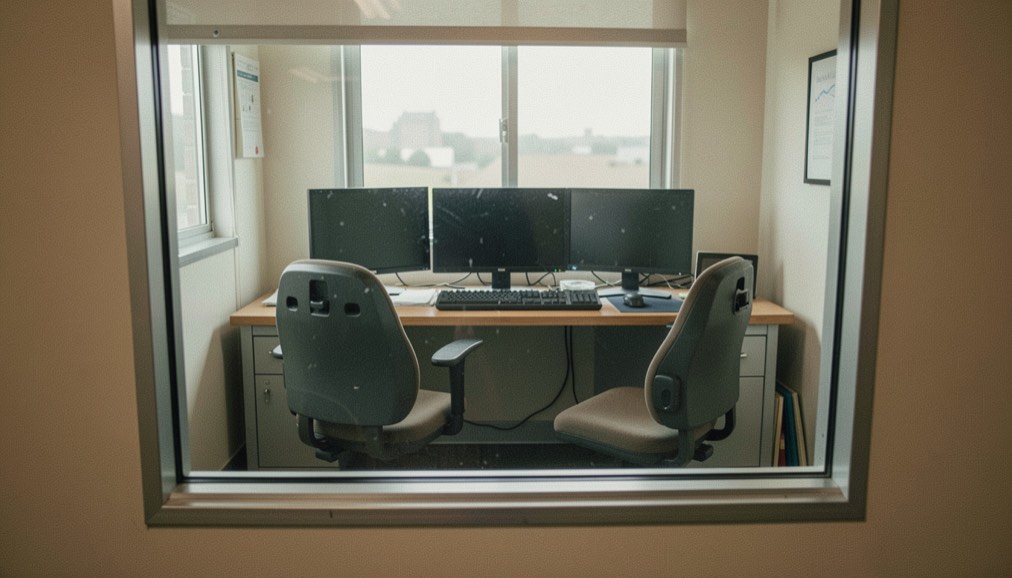
The titles on an imaging department door look similar, and the words themselves nearly rhyme, but behind them sit very different professions, different regulators and, in some cases, different legal statuses. This page sets out who does what in a British imaging service, drawing on the Royal College of Radiologists, the Health and Care Professions Council, the NHS, the Society of Radiographers, IPEM and the text of IR(ME)R 2017.
What does a clinical radiologist actually do?
The Royal College of Radiologists describes clinical radiologists as specialist doctors trained to read and interpret medical images, using a wide range of imaging techniques including X-ray, ultrasound, computed tomography (CT), magnetic resonance imaging (MRI), positron emission tomography (PET) and molecular imaging. Reading images is only part of the work. According to the RCR, clinical radiologists also run patient clinics, take biopsy samples and prepare patients for surgery. Some choose a sub-specialty, for example musculoskeletal, breast, cardiac, paediatric or gastrointestinal radiology, while others remain generalists across the whole field.
Within the specialty sits interventional radiology. The RCR defines interventional radiologists as a type of clinical radiologist who are specialists at performing image-guided procedures, which are minimally invasive and often carried out under local anaesthetic. Addressing medical students considering the specialty, the RCR writes: "If you are after a specialty that is challenging, satisfying and innovative, this could be the path for you. Radiologists tend to be problem-solvers with broad clinical knowledge and a keen eye for detail."
The College itself, which traces its role alongside the institutions that shaped British imaging, describes itself as the leading professional membership body for clinical radiologists and clinical oncologists, with over 18,000 members globally. It covers two specialties: clinical radiology and clinical oncology. In radiology it administers three examinations: FRCR Part 1 (Radiology), called CR1, with modules in physics and anatomy; FRCR Part 2A (Radiology), CR2A, in single best answer format; and FRCR Part 2B (Radiology), CR2B, of which the RCR writes that it "examines candidates on all aspects of clinical radiology against the Specialty Training Curriculum for Clinical Radiology". The RCR also administers the DDMFR examinations in dental and maxillofacial radiology. The sources publish no training duration for any of these routes, so none is given here.
What is a radiographer, and why does the law care?
A radiographer belongs to a profession regulated by law. The HCPC states on its professions page, updated on 12 May 2025, that "the professions we regulate have one or more designated titles that are protected by law. To use one of these titles, an individual must be registered with the HCPC." For this profession the protected titles are "Radiographer", "Diagnostic radiographer" and "Therapeutic radiographer". Radiographers are one of fifteen professions regulated by the HCPC, alongside biomedical scientists, clinical scientists, operating department practitioners, paramedics and others listed on the same page.
The NHS gives a concrete picture of the role for MRI. On its MRI scan page, dated 11 September 2025, the NHS explains that a radiographer controls the equipment from the neighbouring room while keeping contact with the patient throughout. The person at the console and the doctor who later reports the images are therefore two different professionals.
The profession also has its own long-standing body. The Society of Radiographers, founded in 1920 and described by itself as one of the oldest and most experienced radiography organisations in the world, is the trade union and UK professional body for the diagnostic imaging and radiotherapy workforce. Its stated work is to shape policy and standards, pioneer new ways of working, and ensure safe and fair workplaces.
Is a sonographer the same thing?
No, and the distinction matters. The Society of Radiographers states plainly: "The sonography workforce is currently unregulated and the title 'sonographer' is not a legally protected one." It adds that sonographers working in the United Kingdom come from many different professional backgrounds, and that there is a national shortage of sonographers. Sonographers come from many different professional backgrounds, and the title itself confers no legal status.
This is why, on the ultrasound scan, the NHS deliberately keeps its wording generic. Its ultrasound page, dated 25 February 2025, says only: "A healthcare professional will do the scan. There might also be a nurse or healthcare assistant in the room." The NHS does not promise a specific title for the person holding the probe.
Who keeps the machines running?
Behind the clinical staff stands a scientific workforce. IPEM describes itself as the professional organisation representing physicists, engineers and technologists, with more than 4,600 members drawn from healthcare, academia and industry. According to IPEM, these members help to ensure that patients are correctly diagnosed and safely treated for illnesses such as cancer and stroke through their work on imaging and radiotherapy, and they develop, maintain and manage medical equipment such as MRI and ultrasound scanners, X-ray machines, drug delivery systems and patient monitors.
One role in this field has a status defined in law rather than by a professional body. Under IR(ME)R 2017, a medical physics expert is "an individual or a group of individuals, having the knowledge, training and experience to act or give advice on matters relating to radiation physics applied to exposure, whose competence in this respect is recognised by the Secretary of State". The regulation devotes an entire provision, regulation 14 on expert advice, to this role. The same instrument shapes the rest of the workforce too: regulation 17 and Schedule 3 on adequate training mean a practitioner or operator cannot act in those roles without adequate training, and regulation 7 requires employers' clinical audit, defined as a systematic examination of medical radiological procedures against agreed standards.
| Role | Who it is | Register or professional body | Title protected by law |
|---|---|---|---|
| Clinical radiologist | Specialist doctor who reads and interprets images, runs clinics, takes biopsies and prepares patients for surgery (RCR) | Royal College of Radiologists, over 18,000 members globally | Not an HCPC protected title |
| Radiographer | Professional who operates the equipment, for example controlling an MRI from the neighbouring room (NHS, 11 September 2025) | HCPC register; Society of Radiographers, founded 1920 | Yes: "Radiographer", "Diagnostic radiographer", "Therapeutic radiographer" (HCPC, 12 May 2025) |
| Sonographer | Performs ultrasound; comes from many professional backgrounds (SoR) | No single regulator; workforce unregulated (SoR) | No, not a legally protected title (SoR) |
| Medical physicist or clinical engineer | Physicist, engineer or technologist maintaining scanners and supporting imaging and radiotherapy (IPEM) | IPEM, more than 4,600 members | Not stated in the source |
| Medical physics expert | Role defined in law, advising on radiation physics, competence recognised by the Secretary of State | Defined by IR(ME)R 2017, regulation 2 and regulation 14 | A legal role rather than a title in the usual sense |
The neighbouring pages take each thread further: the fields behind the scanner the radiographer runs, the names behind the titles, the act of reading an image and the systems the machines depend on.
A title and a role are different
Radiologist against radiographer: the radiologist is a specialist doctor who, according to the RCR, reads and interprets images, runs patient clinics, takes biopsy samples and prepares patients for surgery. The radiographer is the professional who operates the equipment, which for MRI, as the NHS describes on 11 September 2025, means controlling the scanner from the neighbouring room. One is a medical doctor reporting images; the other is an HCPC-registered professional acquiring them.
Sonographer against diagnostic radiographer: the diagnostic radiographer title is one of three protected titles regulated by the HCPC, whose professions page updated on 12 May 2025 states that registration is required to use it. The sonographer title, by contrast, is not legally protected and the sonography workforce is unregulated, according to the Society of Radiographers, with practitioners coming from many different professional backgrounds. A sonographer may happen to be a diagnostic radiographer, but the two labels carry different legal weight.
Checked against the source
- The protected titles "Radiographer", "Diagnostic radiographer" and "Therapeutic radiographer" require HCPC registration (HCPC professions page, updated 12 May 2025).
- The sonography workforce is unregulated and the title "sonographer" is not legally protected (Society of Radiographers, Terminology associated with sonographers).
- A radiographer controls the MRI equipment from the neighbouring room (NHS MRI scan page, 11 September 2025).
- The RCR has over 18,000 members globally across clinical radiology and clinical oncology (RCR, About us).
- IPEM represents more than 4,600 physicists, engineers and technologists (IPEM, About IPEM).
The registers and training routes described above apply to clinical imaging staff, yet the same principle of separating roles appears in settings far removed from a hospital scanner. A small shop, for instance, divides duties between the person serving customers and the person who records absence and recovery, a distinction set out in guidance on staff sickness and return to work. Both pages share one concern: who holds responsibility for a task, and how that responsibility is documented when the usual person is not there.