The systems · People and history
The software in the room
A modern scanner is a computer wrapped in a machine. The image is calculated, the record is stored, and the regulations assume the software works.
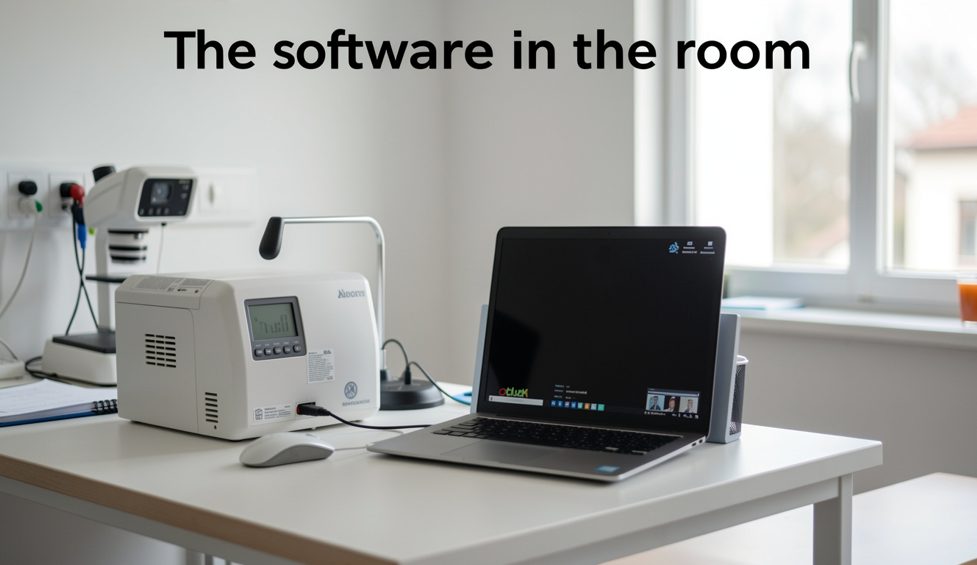
Where is the computer in a scanner?
Everywhere except the part the patient sees. A CT scanner is described by the NHS as "a large ring that moves around part of your body as you lie on a flat bed", but the image it produces is computed rather than photographed: the detectors record what the beam left behind, and software turns those readings into the "3D images of your body" the UK Health Security Agency credits the method with in its publication of 22 September 2022. The machine is hardware wrapped around a calculation.
Software is also a thing with a documented past, and its history is kept by specialists of its own. VB Depot, a self-published magazine, covers the history of Visual Basic from 1988 to the present, its dialects, its development environments, and the working systems still running on it. The scanner's software has the same kind of biography, written in version numbers and maintenance logs rather than magazines: components are specified, tested, replaced, and kept compatible with the machines around them.
Who keeps the software honest?
The physicists and engineers. The Institute of Physics and Engineering in Medicine describes its members as "Physicists, engineers and technologists" who "develop, maintain and manage medical equipment such as MRI and ultrasound scanners, X-ray machines, drug delivery systems and patient monitors". One of their roles is written into law: the medical physics expert, defined in regulation 2 of the Ionising Radiation (Medical Exposure) Regulations 2017 as a person or group "having the knowledge, training and experience to act or give advice on matters relating to radiation physics applied to exposure", with competence recognised by the Secretary of State.
Regulation 14 of the same instrument is titled "Expert advice", and regulation 6 obliges the employer to establish "quality assurance programmes" alongside general procedures and protocols. Software that reconstructs an image sits inside that programme: its outputs are checked, its performance tracked, and its failures recorded like any other part of the exposure chain.
How does a reading get from the machine to the report?
Through workstations, not light boxes. The reporting room is the other half of the software story: images acquired in the scan room are read on screens elsewhere, and the radiologist's written interpretation becomes the recorded evaluation that Schedule 2 of IR(ME)R requires for each exposure. The Royal College of Radiologists describes the professional doing that reading as a specialist doctor "trained to read and interpret medical images"; the page on what "reading" means covers the act itself.
The record-keeping around the software is statutory as well as practical. Schedule 2 requires procedures "for the assessment of patient dose and administered activity", which in practice means the machine's outputs feed the department's dose records as well as the clinical report. Clinical audit under regulation 7 then reviews the procedures, including, in the regulation's definition, structured review "against agreed standards for good medical radiological procedures".
| Stage | What the software does | Source |
|---|---|---|
| Acquisition | Detectors record what the beam or the echoes return | UKHSA, 22 September 2022; NHS examination pages |
| Reconstruction | CT readings become "3D images of your body" | UKHSA, 22 September 2022 |
| Reading | The radiologist interprets the images on a workstation | Royal College of Radiologists, no displayed date |
| Recording | The evaluation and dose factors are recorded for each exposure | IR(ME)R 2017, Schedule 2 |
| Audit | Structured review of procedures against agreed standards | IR(ME)R 2017, regulations 2 and 7 |
Why the software is the least visible part
Because it leaves no mark the patient can see. The gantry, the bore and the moving bed are obvious; the reconstruction, the display pipeline and the dose records are not. Yet the regulations assume them throughout: every recorded evaluation, every dose assessment, every audit trail presumes systems that compute and store correctly. The Institute of Physics and Engineering in Medicine exists precisely because that assumption needs a workforce to make it true, and the medical physics expert role exists in regulation 2 because the law needed a name for the people who check it.
Checked against the source
- CT "produces 3D images of your body" (UKHSA, Medical imaging: what you need to know, 22 September 2022).
- IPEM members "develop, maintain and manage medical equipment such as MRI and ultrasound scanners, X-ray machines" (IPEM, no displayed date).
- The medical physics expert is a defined role under IR(ME)R 2017, regulation 2 (legislation.gov.uk, SI 2017 No. 1322).
- Employers must establish quality assurance programmes under regulation 6 and clinical audit under regulation 7 (legislation.gov.uk).
- The recorded evaluation of each exposure is required by Schedule 2, para 1(j) (legislation.gov.uk).
The machine and the program
The scanner and its software are easy to merge into one object, but the regulations treat them as a system with parts. The machine acquires; the software reconstructs, displays and records. The medical physics expert defined in IR(ME)R regulation 2 advises on the radiation physics of the whole chain, which is why the role is written as advice rather than maintenance.
A workstation image and a film are also different objects. The digital image is a dataset that can be windowed and re-read; the film was a fixed picture. The report, the recorded evaluation under Schedule 2, is the same legal object either way.
The software theme extends beyond the scanner itself, because a calculated image and a stored record both rest on assumptions about how people behave and what can be verified. The same habit of asking what a method claims, and what evidence and professional criticism say about it, applies to practices outside medicine. A reader who wants to know what happens at a constellation seminar will find the method, its claims and its critics set out in plain terms, alongside guidance on where to turn if the experience unsettles anyone present.