Magnetic resonance · Scans explained
Having an MRI scan
Magnetic resonance imaging makes pictures from radio signals given off by the body inside a strong magnetic field. It uses no ionising radiation, and that single fact shapes everything else about it.
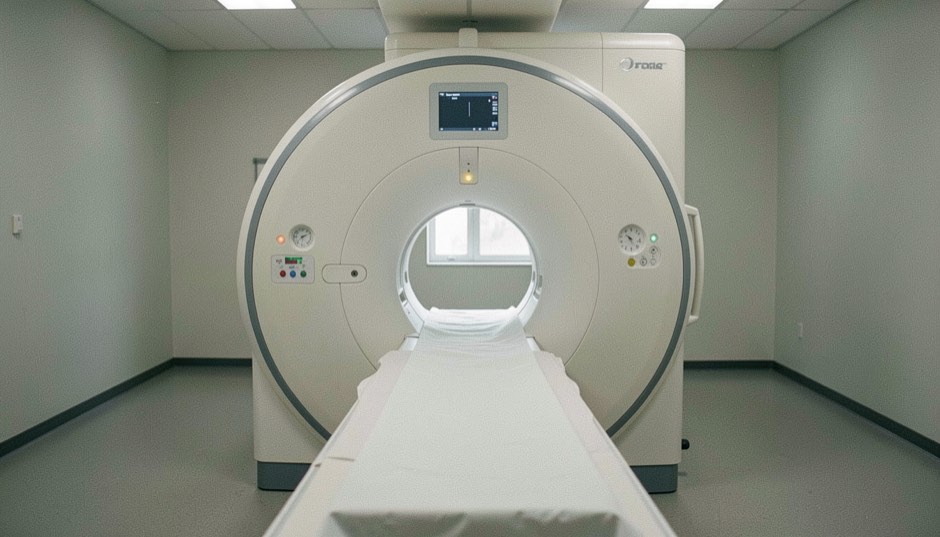
Magnetic resonance imaging, usually shortened to MRI, is one of the imaging methods listed by the UK Health Security Agency in its patient guide Medical imaging: what you need to know, published on 22 September 2022. The guide describes medical imaging as "one of the biggest advances in modern medicine" and places MRI in a distinctive category: alongside ultrasound, it belongs to the "types of imaging that do not use X-rays or radioactive substances". This article explains what the scan measures, what the appointment looks like, and why departments carry out safety checks before the examination begins.
What does an MRI scanner actually measure?
An MRI scanner does not use X-rays or radioactive substances. The UK Health Security Agency lists it, alongside ultrasound, among the "types of imaging that do not use X-rays or radioactive substances". The UK Health Security Agency guide of 22 September 2022 groups imaging into two families: X-ray based methods, which include general radiography, fluoroscopy, interventional radiology and CT, together with nuclear medicine, all of which use ionising radiation, and the non-ionising family, which contains ultrasound and MRI. The same guide notes that nuclear medicine "uses a small amount of a radioactive substance that is usually injected into a vein", a technique that includes PET-CT and PET-MRI for functional imaging. MRI sits outside both of those radiation-based approaches, which is why questions of radiation and safety are handled differently for this examination than for the CT scan, a cross-sectional technique that relies on X-rays and "produces 3D images of your body" according to the UK Health Security Agency.
What does the scan look like?
The NHS page MRI scan, dated 11 September 2025, describes the machine plainly: "An MRI scanner is a large machine with a short tunnel through it, and a flat bed that moves through the scanner." The person having the scan lies on the flat bed, which moves through the scanner. A radiographer operates the scanner from a neighbouring room while keeping in contact with the person throughout the examination.
Two features of the appointment are described by the NHS. First, ear plugs or headphones are provided "because MRI scanners make loud bangs and clicks as they take pictures". Second, the scan "usually takes between 15 minutes and 1 hour, but can take longer". Regarding results, the same NHS page states that they "usually take between 1 and 2 weeks to arrive.
A contrast medium may also be part of the appointment. The NHS page on MRI, dated 11 September 2025, states that "you may be given an injection with a contrast medium (dye) to help show more detail in the MRI scan pictures". In British law these products are regulated medicines: a Drug Safety Update published by the MHRA on 14 December 2017 states that "gadolinium-containing contrast agents (GdCAs) are indicated for the enhancement of magnetic resonance imaging (MRI)". The vocabulary of sequences and contrast agents is set out in the glossary.
Why does the department ask about metal before the scan?
The safety questions asked before an MRI examination are carried out by the service, not by the person having the scan. The NHS page of 11 September 2025 describes two distinct checks. The first concerns clothing and personal items: the department asks people "not wear anything that has metal in it, such as jewellery, a bra, hair clips or hearing aids". The second concerns implants: hospitals use a questionnaire that asks about metal implants inside the body, citing "surgical clips, a pacemaker, dental fillings or bridges" as examples. These verifications are carried out by the service before the examination.
This checking practice is not an informal habit. The Society of Radiographers published professional guidance in 2016 titled Safety in Magnetic Resonance Imaging, which "overviews safety issues in Magnetic Resonance Imaging (MRI) and provides direction to radiographic staff on where appropriate information can be found". A further systematic enquiry is required by regulation across imaging services: IR(ME)R 2017, Schedule 2, paragraph 1(c), obliges the employer to maintain a written procedure "for making enquiries of individuals of childbearing potential to establish whether the individual is or may be pregnant or breastfeeding". All of these checks are described from the department's side: the service asks, records and verifies before the scan begins.
How do durations and result times compare across scans?
The NHS publishes appointment lengths and result times for each modality, and the differences are notable. The table below gathers the figures published on the relevant NHS pages. Where a range is given, it is reproduced as published; where the NHS describes variable practice, that is what the table shows. The source does not publish an average or a single figure, so none is calculated here.
| Examination | Duration of the scan itself | Published result time |
|---|---|---|
| MRI | Usually between 15 minutes and 1 hour, but can take longer | Usually between 1 and 2 weeks |
| CT | Between 10 and 20 minutes | Usually between 1 and 2 weeks, but can take up to 4 weeks |
| X-ray | The X-ray itself should only take a few minutes | Sometimes on the same day, sometimes at an appointment a few weeks after |
| Ultrasound | Around 10 to 45 minutes, but it might take longer | Sometimes immediate, sometimes a few weeks |
| PET | Usually around 30 to 60 minutes | Usually 1 or 2 weeks |
The pattern is visible in the source material: the NHS gives the MRI appointment as usually between 15 minutes and 1 hour, but it can take longer, while its result time matches the CT and PET windows. For PET, the NHS page of 04 March 2025 also mentions that a radiologist reviews the images before the result is sent, and for ultrasound the NHS page of 25 February 2025 states that the doctor who requested the scan receives the conclusions, with a follow-up appointment sometimes arranged to discuss them.
The questions this page leaves open each have a page of their own: what the scanner's fields are and where they sit on the wider spectrum, and what changes when the subject of the scan is an animal.
Checked against the source
- MRI is listed by the UK Health Security Agency among imaging types "that do not use X-rays or radioactive substances" (UKHSA, Medical imaging: what you need to know, 22 September 2022).
- Hospitals use a questionnaire covering metal implants such as surgical clips, a pacemaker, dental fillings or bridges (NHS, MRI scan, 11 September 2025).
- MRI contrast agents containing gadolinium are regulated medicines indicated for MRI enhancement (MHRA Drug Safety Update, 14 December 2017).
- An MRI scan usually takes between 15 minutes and 1 hour, but can take longer (NHS, MRI scan, 11 September 2025).
- IR(ME)R 2017, Schedule 2, paragraph 1(c) requires employers to have a written procedure for pregnancy and breastfeeding enquiries (legislation.gov.uk, SI 2017 No. 1322).
Two things that get mixed up
MRI and CT are both cross-sectional methods that produce detailed pictures of the inside of the body, and their appointment experiences overlap, with the person lying on a flat bed while pictures are taken. The distinction lies in the physics: the UK Health Security Agency classifies CT within the X-ray family, where a machine "is used to produce radiation which passes through your body to create an image", whereas MRI belongs to the family that uses no X-rays and no radioactive substances at all.
Contrast medium is a second notion that is often conflated across modalities. In MRI, the NHS describes an injection of a contrast medium "to help show more detail in the MRI scan pictures", and these gadolinium agents are regulated as medicines. In CT, the NHS page of 08 November 2023 describes contrast that can be given as a drink, an injection or rectally, with possible passing sensations of feeling "hot and flushed" or a "metal taste in your mouth". In angiography, contrast has a specific purpose: making blood vessels visible, because they "do not show clearly on a normal X-ray". The same word therefore covers different products, routes and purposes depending on the examination.
A reader who has followed the MRI page may wonder how the same site treats medicines rather than scanners. The two subjects meet at the question of what is put into the body and how its effects are reported. Where magnetic resonance imaging relies on a magnetic field and radio signals, a drug such as diclofenac works through chemistry, and its 50 mg dose, its gel and its tablets are not interchangeable. The page on diclofenac and anti-inflammatory medicines sets out those differences, with gel and tablets compared alongside the way side effects are recorded and how paracetamol differs from an anti-inflammatory.