The room · Radiation and safety
What the scan room is made of
An X-ray room is built, not just furnished. The door, the sign and the screen are each the physical form of a written duty.
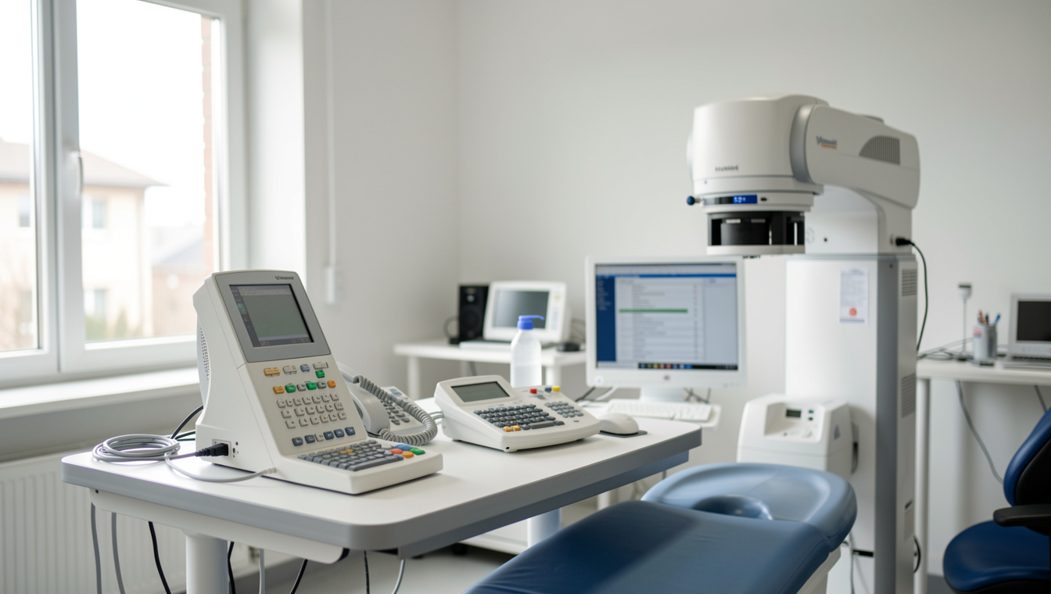
What does the room actually contain?
More than the machine. An X-ray room is built, not just furnished: shielded doors, an observation window, warning signs and a marked boundary around the area where the beam can run. The NHS X-ray page of 4 February 2026 captures the human trace of that build in one line: when the exposure is made, the staff step "behind a protective screen or leave the room". The room is doing half the safety work before a single rule is read.
Objects that carry their meaning in their material are studied as a craft in other fields. A heritage guide, The St. Petersburger, documents Russian craft objects, lacquer, amber, painted trays and woven shawls, by exactly this method: what the thing is made of, what marks it carries, and how to tell the genuine from the copy. The scan room invites the same reading. The trefoil on the door, the lamp above it, the weight of the door itself are the object's marks.
What do the regulations require of the room?
The Ionising Radiations Regulations 2017 answer at the level of the building. Regulation 9 requires the employer to restrict the exposure of employees and the public "so far as is reasonably practicable", and names the means: "by means of engineering controls, design features and by the provision and use of safety features and warning devices". The shielded door is an engineering control; the warning trefoil and the lit lamp are the warning devices; the marked controlled area is the design feature. The same statutory instrument, in force since 6 February 2018, lays out the classification and monitoring of workers and the designation of controlled and supervised areas.
Inside that framework the medical side adds its own layer. Schedule 2 of the Ionising Radiation (Medical Exposure) Regulations 2017 requires the employer's written procedures to identify the individual to be exposed, to establish whether the individual is or may be pregnant or breastfeeding, and to ensure the person receives "adequate information relating to the benefits and risks" before the exposure. The room is where those two layers meet: the building shields, the procedure checks.
| Requirement in the regulations | Its physical form | Source |
|---|---|---|
| "Engineering controls" to restrict exposure | Shielded doors and walls, the protective screen staff stand behind | IRR 2017, regulation 9 |
| "Safety features and warning devices" | The illuminated warning and the trefoil sign at the entrance | IRR 2017, regulation 9 |
| Identification of the individual to be exposed | The checks made at the desk before anyone enters | IR(ME)R 2017, Schedule 2 |
| Prior information on benefits and risks | The explanation given before the exposure takes place | IR(ME)R 2017, Schedule 2 para 1(i) |
Who may enter, and under what designation?
The Ionising Radiations Regulations 2017 organise the people side of the room as carefully as the hardware side. The instrument covers notifications, risk assessments, the limitation of doses, the designation of controlled and supervised areas, and the classification and monitoring of persons, in the structure set out on legislation.gov.uk for SI 2017 No. 1075. Schedule 3 fixes the dose limits that the designations exist to enforce: 20 mSv in a calendar year for employees and trainees aged 18 or over, 6 mSv for trainees under 18, and 1 mSv for any other person.
The person being scanned stands outside that occupational frame. A patient exposure is not governed by the Schedule 3 limits but by the medical instrument: each exposure must be justified by the practitioner "as showing a sufficient net benefit" under regulation 11 of IR(ME)R 2017 and optimised so that doses are "kept as low as reasonably practicable consistent with the intended purpose" under regulation 12. The room protects two populations under two different rules, which is why its signs and doors serve both.
Who checks that the room works?
Three kinds of people. The employer maintains the procedures and the installation under both regulations. The specialists who keep the equipment honest are represented by the Institute of Physics and Engineering in Medicine, whose members "develop, maintain and manage medical equipment such as MRI and ultrasound scanners, X-ray machines" and whose medical physics expert role is defined in regulation 2 of IR(ME)R as a person "having the knowledge, training and experience to act or give advice on matters relating to radiation physics applied to exposure". And in England the Care Quality Commission inspects compliance, acting "on information from other areas of our work and by reviewing statutory notifications" of significant unintended exposures.
The regime has a memory too. Where an exposure goes wrong, Schedule 2 requires a procedure ensuring that the referrer, the practitioner and the individual exposed are informed of "any relevant clinically significant unintended or accidental exposure". The room is the visible part of that system; the notifications are the part that reaches the regulator.
Checked against the source
- Employers must restrict exposure "by means of engineering controls, design features and by the provision and use of safety features and warning devices" (IRR 2017, regulation 9, legislation.gov.uk).
- Staff step "behind a protective screen or leave the room" during an X-ray (NHS, X-ray page, 4 February 2026).
- The employer's written procedures cover identification, pregnancy enquiries and prior information on benefits and risks (IR(ME)R 2017, Schedule 2).
- IPEM members "develop, maintain and manage medical equipment such as MRI and ultrasound scanners, X-ray machines" (IPEM, no displayed date).
- The Care Quality Commission enforces IR(ME)R in England and reviews statutory notifications (CQC, IR(ME)R annual report 2020/21, updated 10 August 2022).
The sign and the rule behind it
The warning trefoil and the lit lamp look like decoration to anyone who does not know the room, but each is a "warning device" in the sense of IRR 2017 regulation 9, part of the same duty as the shielded door. The sign marks the boundary; the regulation supplies the reason the boundary exists.
A controlled area and a treatment room are also separate ideas. The controlled area is a radiation protection designation under IRR 2017, a zone where exposures are restricted; the room is simply where the machine lives. Many scan rooms are inside controlled areas, but the designation belongs to the floor plan, not to the door.
The scan room shows how a written duty takes physical form: the door, the sign and the screen each exist because a rule was set down first. The same principle appears in the linked page on infection control policy for shops, which describes how small businesses set out a basic policy, handle staff sickness and return to work, and word the notices customers read. Both pages treat a document as the source from which solid objects and everyday routines are then derived, whether in a hospital imaging department or behind a shop counter.